
 As churches in God’s Kingdom begin to shed the introspective tendencies of the past few years, the question arises, “Where do we go from here?” Some guidance can be gleaned from Acts 15
Some time later Paul said to Barnabas, “Let us go back and visit the brothers in all the towns where we preached the word of the Lord and see how they are doing”…They had such a sharp disagreement that they parted company. Acts 15:36-39
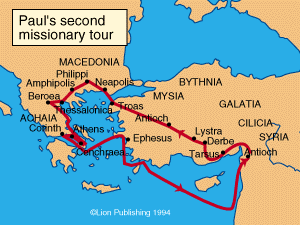 As churches in God’s Kingdom begin to shed the introspective tendencies of the past few years, the question arises, “Where do we go from here?” Some guidance can be gleaned from Acts 15 when the apostle Paul suggested to his fellow evangelist Barnabas that they “visit the brothers in all the towns where we preached the word of the Lord and see how they are doing.” The fact that Paul’s suggestion led to a “sharp” disagreement between our brothers in the early church is the usual emphasis given to these verses and it is easy to forget the context that a change of missionary focus was taking place. Paul, led by the Spirit of God, realized that there are times when you should double back on your path and rebuild and strengthen ministries that have already been started. There is no doubt that coming up with the right approach to rebuilding may lead to spirited discourse, but there is also little question that young churches need to be built up and encouraged by more experienced ministers and congregations.
A challenging chapter in our recent church history includes the story of larger churches taking resources from smaller ones for the sake of building up leadership teams and training future full time workers. Sadly, a migration of talent and funding took place that left many small churches weakened and with little or no leadership. Nathan’s stinging rebuke of King David after describing the parable of the one ewe lamb being taken by the rich ruler who had an abundance (2 Sam. 12:5) comes to mind.
As larger churches have begun to regain their strength and vision for missions, we expect that new church plantings will be on the increase. However, the strengthening of existing domestic churches by larger congregations should also be an area of strong focus. After heroic efforts in the past to start new congregations, there are now numerous congregations that are likely to cease to exist unless they are strengthened. The former model of absorbing the resources of smaller congregations can be changed so that local churches are given to and their existing leadership team is encouraged.
The obvious needs for smaller churches are to be strengthened by reinforcements and funding. An emerging opportunity for strengthening is found in the members of larger churches who were converted to Christ at a young age, dated and married in the church, and raised children who have gone off to college or gotten married themselves. Many of these empty nesters are turning to each other and saying, “I’m not done yet, I want a new challenge!” One such couple is Larry and Nancy Davis from the
Funding is always an issue that can create a pit in the stomach of a church’s leadership. As Elders and church Boards try to cover local expenses and keep the home congregation “fed and clothed” in Christ, there always seems to be more requests than resources. Our churches have come through a time when finances have been stretched and meeting local needs has been difficult. Thankfully, those times seem to be passing. Overseas missions contributions and gifts to the poor are regaining ground in many churches. Members are asking if they can meet specific needs and some have given large anonymous contributions. As this positive spirit of sacrifice increases, we should not forget the need to financially strengthen smaller churches.
Recently, the
The
In Him,
Walter Evans
Elder and Evangelist of the Greater


